
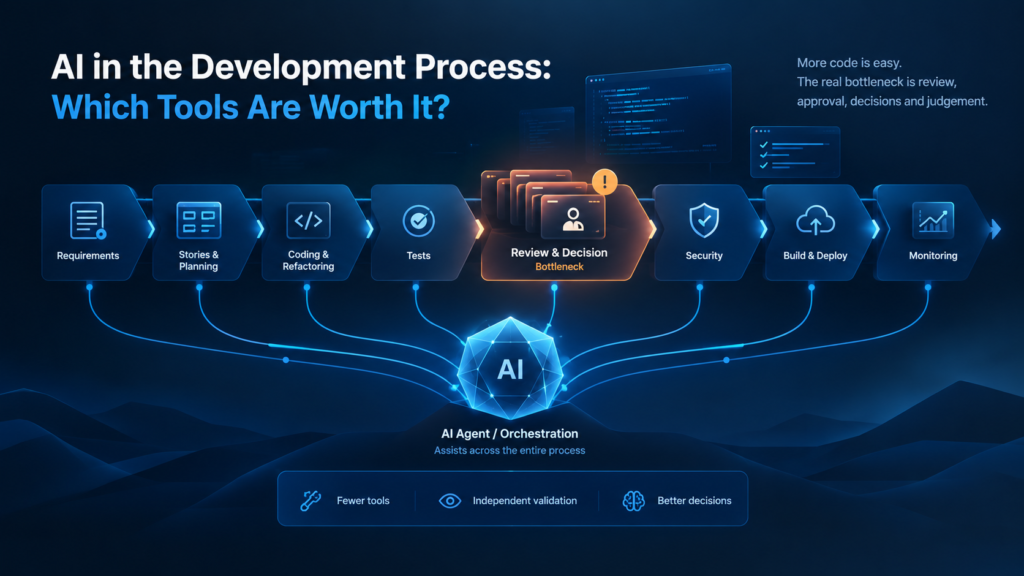
Today there is an AI tool for every step of the lifecycle. Requirements, stories, code, tests, reviews, security, documentation, deployment, monitoring. I checked the main candidates for each step. What still exists, what changed in 2026, and what I would really use.
Start with this number
Before you buy anything, look at the data. DORA research describes a paradox, and Atlassian found the same thing in 2026. AI assistants raise the output of one person a lot. About 21 percent more tasks done, and 98 percent more pull requests merged. But the delivery numbers of the whole organisation stay flat.
The reason is simple. Writing code is not the bottleneck any more. The bottleneck is review, approval and decision. Studies of millions of pull requests show that code written by AI waits much longer for its first review than code written by hand. The queue only moved to a different place.
So I use one rule:
An AI tool only pays off where the queue really is. More generation in front of a blocked review process makes the jam worse, not better.
This also gives the order of adoption. First review, then security, then generation. If you start at the other end, you buy yourself a backlog.
Requirements and use cases
Claude is my default here. There is no process, no licence, no format of its own. It structures the idea, asks questions back, writes acceptance criteria and finds the gaps. For most requirement work this is enough.
Jama Connect is the option for regulated work. Its Advisor scores requirements against INCOSE rules and EARS notation. It explains which rule was broken and proposes a better version, and it can split one statement into several statements that you can test separately. It also creates test cases that link back to the source requirement. The new thing in 2026 is an MCP Server that gives approved specifications to Claude, Codex, Cursor and Copilot. This is the moment where requirements management stops being a document archive and starts being a context source for agents. Price is on request, and the Advisor and the MCP Server cost extra on top of the seats.
For turning use cases into stories, Rovo can read product documents, notes and requirement pages and produce stories with acceptance criteria inside Jira and Confluence. Useful if you already work with Atlassian. Not a reason to introduce Atlassian. In any case, cutting a story is a design decision and not a format conversion, so I treat the output as a draft and remove a lot of it.
Development, refactoring and architecture rules
Claude Code is what I use for everything that touches many files. Big refactorings, migrations, and loops of build, test and fix. The value is that I can delegate a task and then review the result. It is not about autocomplete.
Cursor is still the better editing environment. Cursor 3 came in April 2026 with a window for several agents working in parallel across repositories, with cloud agents in sandboxed virtual machines, and with Bugbot Autofix. The old split between terminal agent and IDE assistant does not hold any more. The real difference is the attitude. Claude Code assumes that you delegate. Cursor assumes that you edit.
One warning about architecture compliance. No tool checks your architecture. These tools check rules that you wrote down first, in .coderabbit.yaml, in the Qodo rules system, or in CLAUDE.md. The value comes from writing the rules, not from checking them.
Tests
Qodo Cover is the agent for the command line and for CI. It finds paths without tests, writes tests and validates them. Qodo 2.0 came in February 2026 with an architecture of several agents, and it has the best F1 score in benchmarks against seven other tools, with 60.1 percent. That is the best number in this field. It also means that four findings out of ten are noise or a gap.
KaneAI writes tests from prompts in normal language, based on Jira tickets, specifications or screen recordings, and exports them to Selenium, Playwright, Cypress or Appium. Note the name change. LambdaTest became TestMu AI in January 2026. KaneAI still runs, and old accounts, scripts and API keys still work. Prices go from about 19 dollars per agent for Starter up to 199 dollars for Max.
Claude Code also writes tests, with no extra licence. For most projects this is enough. The real question is if you want a separate coverage agent running all the time in CI.
One thing the vendors do not say. Generated tests need review. One or two minutes per test sounds small, but if you generate hundreds every week it becomes its own job. If you add test generation without adding review time, you get green bars that mean nothing.
Pull request review
CodeRabbit has the biggest volume. More than 13 million pull requests reviewed, free for open source, about 24 to 30 dollars per developer per month, and support for GitHub, GitLab, Bitbucket and Azure DevOps. It is fast, it has little noise, and you can write the rules in normal language. Its known limit is business logic. It finds SQL injection and null pointers, but it cannot know if your discount calculation is correct.
Qodo Merge, which started as the open source project PR Agent, is deeper and more expensive. It analyses context across several repositories, has SOC 2 Type II, and can run on your own servers.
More important than the choice is a recommendation from DORA that I agree with. Give the AI feedback to the author while the code is written, not to the reviewer afterwards. Both tools have IDE integrations now, and this is the part you should switch on first.
Security
Snyk is still the default. Snyk Code plus Agent Fix is the base. Evo Agentic Development Security, from June 2026, adds a layer that controls the agent itself instead of only scanning the result. It governs which tools and MCP servers the agent pulls in, what it does while it runs, and what it generates.
The argument behind this is the best one in this whole area, and it is true far beyond security:
The generator cannot be the validator.
If you run Claude, Cursor, Copilot and Codex at the same time, you cannot let each vendor grade its own output. Snyk gives a useful number for its own part. A frontier model alone produces a secure and working fix about 72 percent of the time. With the security knowledge of Snyk on top, the rate of fixes ready to merge goes up to about 82 percent. So one fifth stays manual work.
A good test for your own organisation. Ask for a full list of all MCP servers and skills running on the machines of your developers. In most companies this list does not exist.
Documentation
Mintlify now calls itself a knowledge platform for agents. The feature that matters is Workflows. When a change is merged, the agent reads the diff, finds the pages that are affected, writes the updates and opens a pull request. This makes documentation a side product of shipping, which is what “keep the documentation in sync with the code” really means. Watch the cost model. In 2026 it moved to a free Starter plan plus metered AI credits, with packages from about 100 dollars per month and extra cost per credit above that. The platform is cheap. The usage is not.
Delivery
GitHub Actions with the Copilot coding agent is my favourite part of this market, because it invents the smallest number of new concepts. You assign an issue to the agent, it works in the background in an environment powered by Actions, it pushes commits to a draft pull request, and it shows the session logs. Review, code owners and branch protection all stay the same. Agent HQ opens the same building blocks to agents from Anthropic, OpenAI, Google, Cognition and xAI. One cost detail that is easy to miss. Since 1 June 2026 code review workflows also use Actions minutes, and billing is based on usage.
Harness goes furthest for large organisations. Its DevOps Agent creates and edits pipelines, analyses failures, and writes OPA Rego policies for compliance. It runs on Claude Opus through Bedrock and Vertex AI. In June 2026 it added Autonomous Worker Agents, which run as a normal step inside the pipeline, with a sandbox, limited credentials and an audit trail, and you can choose the model provider per pipeline. Customers say the first agent in production took about four days. Check what your own plan really includes. The Harness roadmap page still listed parts of the agent offer as limited preview at the same time as the general availability announcement.
Monitoring
Datadog has Bits AI SRE, now called Bits Investigation. It starts without any prompt when an alert fires, reads the same telemetry as the team, knows the architecture and follows the runbooks. It was tested in more than 2,000 customer environments. Billing goes through AI credits, at roughly 6.50 dollars per investigation.
Dynatrace does the opposite. Deterministic causal AI as the base, with Davis AI, the Smartscape topology and Grail, and agentic AI on top. The story is a ladder of maturity, from reactive operations to preventive operations, then to supervised operations and finally to autonomous operations. If a wrong automatic fix costs more than the outage itself, this deterministic base is the better argument.
Both vendors say the same thing underneath. The more code agents write, the more complex and less understood production becomes. So you grow your observability because of the agents, not in spite of them.
What you can build yourself
A large part of this list is a prompt plus context plus access to a system. Today that is a skill or an MCP server, and it takes an afternoon.
Things worth building yourself:
- Project conventions as a skill. Architecture rules, naming, layering, error handling. Everything you repeat in every review.
- A skill that turns use cases into stories in your own format.
- MCP servers for internal systems where no product exists.
- Review checklists for your domain, which cover exactly what a generic reviewer cannot know.
The limit is scale and liability. I would not rebuild a security scanner, and I would not rebuild an audited INCOSE rule set. But half of what is sold as an “AI platform” is a collection of prompts with an enterprise contract around it.
My stack
- Requirements: Claude plus my own skills. No process overhead, my own format.
- Stories: Claude. Jira only where the client already uses it.
- Development: Claude Code. Delegation instead of autocomplete.
- Tests: Claude Code. A coverage agent only on large codebases.
- Pull request review: CodeRabbit. Cheap, fast, native in GitHub, free for open source.
- Security: Snyk. Independent from the generator.
- Documentation: Mintlify for API products, otherwise Markdown in the repository.
- CI and CD: GitHub Actions with the Copilot coding agent.
- Monitoring: whatever the client already runs.
Client stacks look different, because compliance, data residency and existing contracts matter more than my taste. But the order of adoption stays the same.
The real question
Is IT work moving away from doing, towards consulting, organisation and requirements analysis?
The data supports this in part. Job ads that ask for experience with AI coding tools grew by 340 percent between January 2025 and January 2026, while ads for pure implementation roles fell by 17 percent. And the gains are not equal. About 35 to 40 percent on simple greenfield tasks, but under 10 percent on complex legacy code. What the machine does well is exactly what was already easy.
Still, I would make the thesis softer. What disappears is not the doing. What disappears is the doing that nobody thought about. The third almost identical endpoint in the same sprint. What stays, and gets more expensive, is judgement. Where do I cut the interface? Which consistency guarantee do I really need? Which generated test checks something real, and which one only checks itself?
You do not get this judgement from requirements workshops. You get it from building. If you spend five years only moderating and cutting tickets, you lose exactly the substance that made you valuable as a consultant.
So my working thesis is this. Not away from doing, but away from arbitrary doing. Fewer tools, but tools you understand. And the will to still write the core yourself. Not out of nostalgia, but because otherwise you cannot judge what the machine gave you.
