
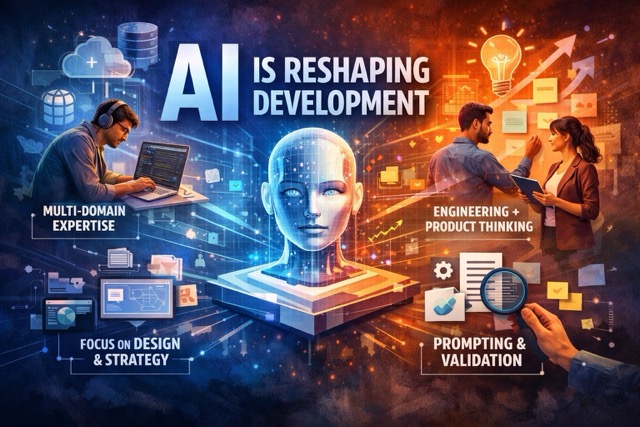
One of the most profound changes AI brings to development is a fundamental paradigm shift in how expertise works. Traditionally, becoming effective in a domain—whether frontend, backend, infrastructure, or data—required years of focused specialization. Today, AI tools are collapsing those barriers.
Developers can now operate competently across multiple domains with far less ramp-up time. Tasks that once demanded deep, narrow expertise are increasingly accessible through tools like Claude Code. In practice, this can lead to dramatic productivity gains—developers report completing what would have taken months of work in a matter of days. The implication is clear: leverage is no longer tied strictly to experience depth, but to how effectively one can collaborate with AI.
“The key is to use LLMs as incredibly capable assistants that can handle implementation details and exploration, while developers focus on architecture, validation, and maintaining quality standards.“
The Blurring Line Between Engineering and Product
This shift is also dissolving traditional boundaries between roles. The long-standing separation between engineering and product thinking is becoming less relevant.
Modern developers are no longer just implementers—they are expected to:
- Identify valuable problems
- Prototype and test solutions quickly
- Iterate based on real feedback
Success increasingly depends on being results-oriented, not just technically proficient. The developers who stand out are those who can spot opportunities others miss and move quickly to validate them.
From Syntax to Strategy
AI is also transforming how developers think.
By handling much of the low-level complexity—syntax, configuration, and boilerplate—AI frees developers to operate at a higher level of abstraction. Instead of focusing on how to implement something, developers can spend more time on:
- System design
- User experience
- Product strategy
This is a cognitive shift as much as a technical one. Developers are becoming designers of systems and outcomes, not just writers of code.
A New Skill Stack
As the nature of the work changes, so do the skills required to excel.
The most valuable capabilities now include:
- Prompt engineering: Clearly expressing intent to get useful results from AI
- System thinking: Understanding how components interact at a high level
- Critical evaluation: Verifying correctness, performance, and security of AI-generated code
Deep specialization is not disappearing—but it is no longer the only path to impact. The ability to direct and validateAI is becoming just as important as the ability to build from scratch.
The Rise of the Generalist
Perhaps the most exciting consequence of this shift is the democratization of development.
Complex tasks that once required dedicated specialists are now within reach of adaptable, curious developers using AI assistance. This opens the door for a new kind of builder:
- Multi-disciplinary
- Fast-moving
- Comfortable operating across boundaries
Rather than narrowing their focus, developers can expand it—becoming generalists with powerful tools that amplify their reach.
